
 Meguro Fudo Son
That is the thing about New Year, the festival really starts in the last few days of December when people go to the temples and shrines, more about this dualism later, to buy the necessary items to decorate the home with for the transition from old to new. Without these items Japanese homes would certainly not experience good fortune in the new year so a thousand yen here and a thousand yen there and the monks and priests will supply the necessary prayers, incantations, symbols and devices that promise every chance of wealth, health and happiness. (Though it should be noted that the first and the last are inseperable).
 The Temple staff protecting the wealth,
health and happiness of the people
From first light on New Years Eve the Buddhist temples and the Shinto shrines are ready for the crowds. All day and all through the night, the big moment is the first dawn of the new year, people absolutely pack out these religious sites all over Japan. According to the wiki on Shinto shrines it is estimated that there are 100,000 across Japan. The number of temples is not a figure I can find and that is probably because it is simply uncountable. The number of these sites may seem vast but it is absolutely nothing to the number of people who attend them at New Year.
 Cleansing the way
For regular readers of this blog it will come as no surprise whatsoever that on entering the temple the first task is to wash your hands. This is of course a ritual cleansing but I also believe that it is a deep statement of specific identity, "I am Japanese"
 The ritual never ceases
What I have personally found truly surprising is not just the numbers of people but the complete cross section of society, when I say everyone goes I do mean everyone. There is an outstandingly high probability that members of the Atheist Society of Japan arrange to go together in a group and probably follow the rational, "Yes, obviously we don't believe in any of this but this is New Year and after all we are Japanese." Last night I even saw a group of Japanese punks washing their hands before going onto the next stage, spiritual purification.
 First the physical then the spiritual cleaning
 First the physical then the spiritual cleaning
Wander up a few more steps from the water trough and you have a massive pile of incense sticks burning like a fireworks night bonfire and wafting large clouds of deeply scented smoke around the people. Most stop and "bathe themselves" in the smoke by pulling it in and around their bodies.
 The burning desire for complete cleanliness
 The burning desire for complete cleanliness
Observing this spiritual washing for some time what again is so amazing is that everyone appears to get involved. Young-old, goth-company man, punk-fashionista, executive-petrol station attendant, they all seem to want some of this cleansing ritual, and for very good reason. This is a moment when the goodness of the smoke gives you the opportunity to ask for a wish for the New Year and that really gives the insight about what is going on here.
 Not a smoke screen
 Not a smoke screen
Once more this is Japan and this is the Japanese way of doing things. New Year is a re-affirmation of that Japanese identity, it is a defining moment of culture in the social and mythological calender. Yes, around the temples there are many stalls, a sort of fairground (spaces rented from temple or shrine of course) which provides a few light entertainments, some additional opportunities to buy spiritual commodities but dominated by food stalls. These food stalls are uniquely Japanese fare, the American hamburger or similar foreign fast food staples just simply do not exist within this particular universe. Here the seasonal favourite of octopus tentacles and squid hit the griddle plates with a hiss of steam.
 Something to chew on
 Something to chew on
But it would be completely wrong to write off the attendance of young people at the temples and shrines as just the chance to "go to the fair". Of course there are some that just hang around the stalls but the vast majority ascend the steps, wash their hands and then cleanse their spirit with incense smoke before entering into the inner sanctum. There in Meguro Fudo Son they stand before the statue of the Buddha, clap twice and join their hands in a silent prayer with head bowed before throwing coins into the enormous trough before them.
This goes on all New Years Eve through to the dawn of New Years Day, throughout that day and on for another three days. People visit temple and shrine, they walk around or get the all night tube trains and go from site to site, eating, drinking and offering a quick prayer.
 For whom the bell tolls?
This is the great beauty of the Japanese mythologies that those in the west fail so often to grasp. There is no monotheism in Japan; that dreadful mythology of the imperialism of the soul and the divine right of the one and only true God to dam into hell the non-believer, heretic and anyone who says their prayers in the wrong way. No, when people ask me, "Is your wife Buddhist or Shinto?" then I know they haven't got a clue about the Japanese culture. In Japan you can be both Buddhist and Shinto because neither are exclusive, they are inclusive beliefs that recognise there are many ways of seeing the spiritual aspect of humanity.
Besides this we all have to remember the Japanese qualities touted by this blog repeatedly. The Japanese are fundamentally pragmatists and they dislike deeply any level of uncertainty. Shinto is very much about being in tune with the kami (let's just say this means spirits here but it is actually much more than this) and thereby good fortune is yours in life. Once again, a whole paper could be written just on that word 'fortune' and what it means in Japan. The key point here is that Shinto is an ideal belief for making life good, so the Japanese use it mainly for the rituals of birth and marriage. On the other hand Buddhism promises re-incarnation, hmmm says the Japanese psyche, sounds good to me, where do I sign up? So Buddhism deals mostly with the rituals of death.
Obviously, for both to work you still have to put the effort into both of them. In observing all the feasts and rituals you pay the shrines and temples in a constant stream of coin, an investment in keeping all life harmonious and well balanced. After all, surely this is the pragmatic spiritual solution and doesn't leave room for the appearance of uncertainty! There is a Japanese saying that reflects exactly this pragmatism and certainty; "If one God throws you out you always have another to pick you up."
On New Years Day we went to the Hei Shinto shrine, a shrine associated with the Imperial family and with close ties to the sport of sumo wrestling. The image you see above does not give you anything like the true story here. We arrived at 16.00hrs and the queue to get into the shrine was out in the street.
Shrine security men in blue police style uniforms and armed with megaphones were marshalling this huge snake from the pavement, up six flights of steps (about thirty steps in each flight), in through the entrance, in through the outer courtyard to the main entrance for the inner courtyard. At this point you started to realise the enormity of the operation. You see the shrine is set in a square with roads on all four sides and queues were feeding in from all four street entrances. When you managed to arrive at the main inner courtyard then all four queues were merged into one gigantic parade ground file.
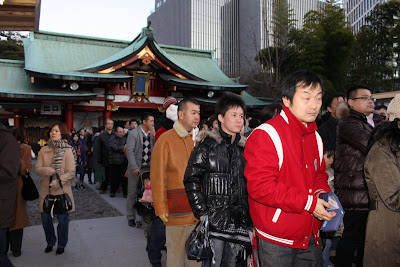 At least forty minutes to get this far, at least!
This goes on all New Years Eve through to the dawn of New Years Day, throughout that day and on for another three days. People visit temple and shrine, they walk around or get the all night tube trains and go from site to site, eating, drinking and offering a quick prayer.
 For whom the bell tolls?
This is the great beauty of the Japanese mythologies that those in the west fail so often to grasp. There is no monotheism in Japan; that dreadful mythology of the imperialism of the soul and the divine right of the one and only true God to dam into hell the non-believer, heretic and anyone who says their prayers in the wrong way. No, when people ask me, "Is your wife Buddhist or Shinto?" then I know they haven't got a clue about the Japanese culture. In Japan you can be both Buddhist and Shinto because neither are exclusive, they are inclusive beliefs that recognise there are many ways of seeing the spiritual aspect of humanity.
Besides this we all have to remember the Japanese qualities touted by this blog repeatedly. The Japanese are fundamentally pragmatists and they dislike deeply any level of uncertainty. Shinto is very much about being in tune with the kami (let's just say this means spirits here but it is actually much more than this) and thereby good fortune is yours in life. Once again, a whole paper could be written just on that word 'fortune' and what it means in Japan. The key point here is that Shinto is an ideal belief for making life good, so the Japanese use it mainly for the rituals of birth and marriage. On the other hand Buddhism promises re-incarnation, hmmm says the Japanese psyche, sounds good to me, where do I sign up? So Buddhism deals mostly with the rituals of death.
Obviously, for both to work you still have to put the effort into both of them. In observing all the feasts and rituals you pay the shrines and temples in a constant stream of coin, an investment in keeping all life harmonious and well balanced. After all, surely this is the pragmatic spiritual solution and doesn't leave room for the appearance of uncertainty! There is a Japanese saying that reflects exactly this pragmatism and certainty; "If one God throws you out you always have another to pick you up."
On New Years Day we went to the Hei Shinto shrine, a shrine associated with the Imperial family and with close ties to the sport of sumo wrestling. The image you see above does not give you anything like the true story here. We arrived at 16.00hrs and the queue to get into the shrine was out in the street.
Shrine security men in blue police style uniforms and armed with megaphones were marshalling this huge snake from the pavement, up six flights of steps (about thirty steps in each flight), in through the entrance, in through the outer courtyard to the main entrance for the inner courtyard. At this point you started to realise the enormity of the operation. You see the shrine is set in a square with roads on all four sides and queues were feeding in from all four street entrances. When you managed to arrive at the main inner courtyard then all four queues were merged into one gigantic parade ground file.
 At least forty minutes to get this far, at least!
Everyone was patient, everyone was queuing, there was no trouble and everyone conformed, well nearly everyone. Takayama has never been one to wait in line, perhaps that accounts for her having left Tokyo when she was 18. She and I scurried up the steps into the outer courtyard where all the food stalls were. I thought that I was quite happy to just film around that area. I am also not fond of queues and suffer what I like to refer to as creative impatience!!!!!!!!!
 Four minutes later and another three feet further on
 Four minutes later and another three feet further on
But, as Takayama delights in pointing out, I suffer from guilt as a result of a Catholic education. She equally rejoices in her own position, "Guilt, what's the point of that?" So when she came brushing up against me and said, "I found a way in and no need to queue, it's just around the back." I felt a little uneasy knowing her track record in this area. She led me around and sure enough she had found an exit from the inner courtyard and, with a heavy heart beating with a sense of betrayal of thousands of loyal queuers, we entered against the flow of people exiting.
 What it was all about
 What it was all about
Once inside the inner courtyard my emotional burden was relieved because I saw at once the aim of the queuing activity and I hadn't in any way breached that purpose. Before the main shrine there is a row of bells from which hang red and white ribbons. After having made the journey from the street and been patient and polite, once all obstacles had been surmounted, all passage travelled, the queuer found themself before one of these bells and with a quick grasp of the ribbon able to ring it once.
 Ringing in the New Year
This shows you the real difference between the Japanese and us, never in your wildest dreams would you expect to see the souless of Canary Wharf and the spiritless of the Square Mile gathered in prayer. The only shrine our business people know is the mirror in their bathroom!
 Ringing in the New Year
Once they had rung the bell they stood for a few seconds with hands clasped and head bowed making their prayer for the New Year. A quick throw of some coins into the enormous open trough just behind the bells and off to buy some of that special spiritual merchandise. All around, the inner courtyard was lined with booths staffed by men and women in white and red robes. They were selling prayers, charms, fortune predictions for the coming year and spiritual arrows, one of these is a must have for every home.
 Everyone goes to New Years Day
The arrows are made of something like balsa wood, flighted with card, wrapped with a prayer and touched up with red and gold paint, mass produced, not more than 50 pence each to make. Currently, at 150 yen to the pound, the arrows sell for 1000 yen each, about £7.50. These of course are the cheapest arrows, if you pay for a more expensive one it may not look very much different but it will have a much better prayer attached to the shaft.
Around the back in the outer courtyard staff were opening the rear doors to the inner courtyard booths and unpacking a constant stream of merchandising into trolleys inside the booths. If you remember the size of the queue, if you remember that this activity goes on for almost four days, then you have to understand the triumph of logistics that keeps this whole process moving. At a very conservative estimate of a thousand people an hour spending an average minimum of £10 each, each hour for four days then your supply lines need to be good. The temples and the shrines of Japan never, never let their customers down, the organisation and delivery are management models that sparkle with the world famous Japanese efficiency. And if you require a lesson in added value then it has to be worth the 50,000 yen for a private twenty minute consultation with a monk or a priest.
 The little extras that really count
 Everyone goes to New Years Day
The arrows are made of something like balsa wood, flighted with card, wrapped with a prayer and touched up with red and gold paint, mass produced, not more than 50 pence each to make. Currently, at 150 yen to the pound, the arrows sell for 1000 yen each, about £7.50. These of course are the cheapest arrows, if you pay for a more expensive one it may not look very much different but it will have a much better prayer attached to the shaft.
Around the back in the outer courtyard staff were opening the rear doors to the inner courtyard booths and unpacking a constant stream of merchandising into trolleys inside the booths. If you remember the size of the queue, if you remember that this activity goes on for almost four days, then you have to understand the triumph of logistics that keeps this whole process moving. At a very conservative estimate of a thousand people an hour spending an average minimum of £10 each, each hour for four days then your supply lines need to be good. The temples and the shrines of Japan never, never let their customers down, the organisation and delivery are management models that sparkle with the world famous Japanese efficiency. And if you require a lesson in added value then it has to be worth the 50,000 yen for a private twenty minute consultation with a monk or a priest.
 The little extras that really count
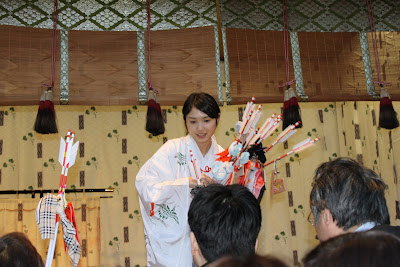
Once you have your arrow then you can tie a handkerchief or strip of material to it, so as to identify it as your own, and hand it to a very elegant lady from the shrine's staff. This lady is a Miko, a messenger of the spirit world and she gathers up the arrows in her arm and takes them to the centre of what appears like a small stage.
 After the queuing, after the bell, after the purchases, a moment of real beauty
In one arm the arrows are gathered like a bouquet, in her free hand she holds a small shaker of golden bells. From the side of this stage a small group of musicians produce a traditional sound with traditional instruments that even a hermit living in a cave on Mars would recognise as Japanese. Our lady with the arrows then begins to perform a ritual blessing, I assume. This is done with slow graceful movements and starts with a bow towards the audience. The audience bow in return.
 Respectful bowing commences the blessing
The lady shakes her bells and then turns slow circles before stopping facing to her left side of the stage. She shakes the bells and then slowly turns more circles until she faces the audience once again. Everyone is silent, everyone is mesmerised, everyone is captivated, this was truly beautiful.
 A final blessing
Once this small ritual is complete our lady of the arrows moves to the front of the stage and shakes the bells over the audience. They all bow as she walks along the front of the stage from her left to her right and finishes with a final bow. Once this is complete she then hands the arrows back and each person holds their hand up to receive the one with their handkerchief on. Once they have reclaimed their arrow they have an opportunity to place some yen in a box, in Japan there are limits to what is for sale but added value is always appreciated, good manners would not allow less.
And so this is my own view of New Years Day in Japan, a small glimpse from a very partial viewpoint. Perhaps you would think that I am just writing from a cynical insight but nothing could really be further from the truth. Yes, I can see humour in what I see each year in Japan but only the humour a foreigner sees in any unfamiliar culture. However, as my stated aim is to understand something of another culture and share with all those who read this blog something of Japan, then we have to put this mix of spiritualities and commercialism into context and that context is cultural.
If you hold on to a deep pragmatism then you accept the way the temples and shrines do business, after all business is a necessary function of life. Japan is the consumer society, I would contend, without peer. As there is no conflict with visiting a Buddhist temple and a Shinto shrine so there is no conflict between the material practicalities and the spiritual practices, both can co-exist without compromise. Ask any Japanese how wealthy the temples are, ask them how good a business is a shrine and they will nod their heads and draw a breath. Senior ladies like HMil may even say they are built on gold and that to get a good funeral you need a high ranking monk for a good afterlife and that costs serious money. But when you are talking 'afterlife' there are not enough coins minted to value that commodity.
 Wrapped in culture
As with everything else in Japan, if there is good customer service and value for money, like the Shinkansen, then it is seen as emblematic of the culture. The people may pay the temples and the shrines year in year out but all over Japan there is a cultural heritage in these buildings that defines an identity you cannot buy into but have to have been born to. The monks and priests spend their lives in prayer to defend the spirit of Japan and even if you don't want to be too involved in the rituals they do all the spadework for you and that is worth the cost. At the end of the day, if you spend New Years Day in Japan you are going to see a lot of people enjoying themselves, together, peacefully and pragmatically. Of that you can be absolutely certain.
 Coals to Newcastle, queueless?
Oh and yes, in the five New Years I have spent in Japan I have never seen anything but Japanese stalls at the temples and shrines. The image above was photographed today at the Hie shrine. Perhaps a trend but I doubt it, it didn't seem like a lot of people were buying. Japan loves its food, loves its tradition and New Year is not a place where I would like to sell cross culturally. However, it reminded me of a night driving back from Exeter to London many years ago. We were hungry, it was nearly 1am in the middle of West Country nowhere but my friend Ali Gullen insisted we pull off of the M5 at the next junction and get a kebab. I told him he was mad, it was midweek, the early hour of the morning and we were heading to a village or town we had never heard of before. Thirty minutes later we were eating kebabs.
And so this is my own view of New Years Day in Japan, a small glimpse from a very partial viewpoint. Perhaps you would think that I am just writing from a cynical insight but nothing could really be further from the truth. Yes, I can see humour in what I see each year in Japan but only the humour a foreigner sees in any unfamiliar culture. However, as my stated aim is to understand something of another culture and share with all those who read this blog something of Japan, then we have to put this mix of spiritualities and commercialism into context and that context is cultural.
If you hold on to a deep pragmatism then you accept the way the temples and shrines do business, after all business is a necessary function of life. Japan is the consumer society, I would contend, without peer. As there is no conflict with visiting a Buddhist temple and a Shinto shrine so there is no conflict between the material practicalities and the spiritual practices, both can co-exist without compromise. Ask any Japanese how wealthy the temples are, ask them how good a business is a shrine and they will nod their heads and draw a breath. Senior ladies like HMil may even say they are built on gold and that to get a good funeral you need a high ranking monk for a good afterlife and that costs serious money. But when you are talking 'afterlife' there are not enough coins minted to value that commodity.
 Wrapped in culture
 Coals to Newcastle, queueless?
Oh and yes, in the five New Years I have spent in Japan I have never seen anything but Japanese stalls at the temples and shrines. The image above was photographed today at the Hie shrine. Perhaps a trend but I doubt it, it didn't seem like a lot of people were buying. Japan loves its food, loves its tradition and New Year is not a place where I would like to sell cross culturally. However, it reminded me of a night driving back from Exeter to London many years ago. We were hungry, it was nearly 1am in the middle of West Country nowhere but my friend Ali Gullen insisted we pull off of the M5 at the next junction and get a kebab. I told him he was mad, it was midweek, the early hour of the morning and we were heading to a village or town we had never heard of before. Thirty minutes later we were eating kebabs.
"You see Jack, we Turks get everywhere and when we do we open a kebab shop."
Ali Gullen, British of Turkish cultural descent.
 source:http://news.bbc.co.uk/2/hi/in_depth/8439594.stm
And is if further confirmation was necessary then you just have to look at this image from the BBC web site showing Japanese businessmen praying at the Kanto shrine on the first trading day of the New Year. In Japan, wealth and happiness are indivisable and pragmatism says, even if you don't believe you still pray, after all, that leaves no room for uncertainty.
 source:http://news.bbc.co.uk/2/hi/in_depth/8439594.stm
This shows you the real difference between the Japanese and us, never in your wildest dreams would you expect to see the souless of Canary Wharf and the spiritless of the Square Mile gathered in prayer. The only shrine our business people know is the mirror in their bathroom!
